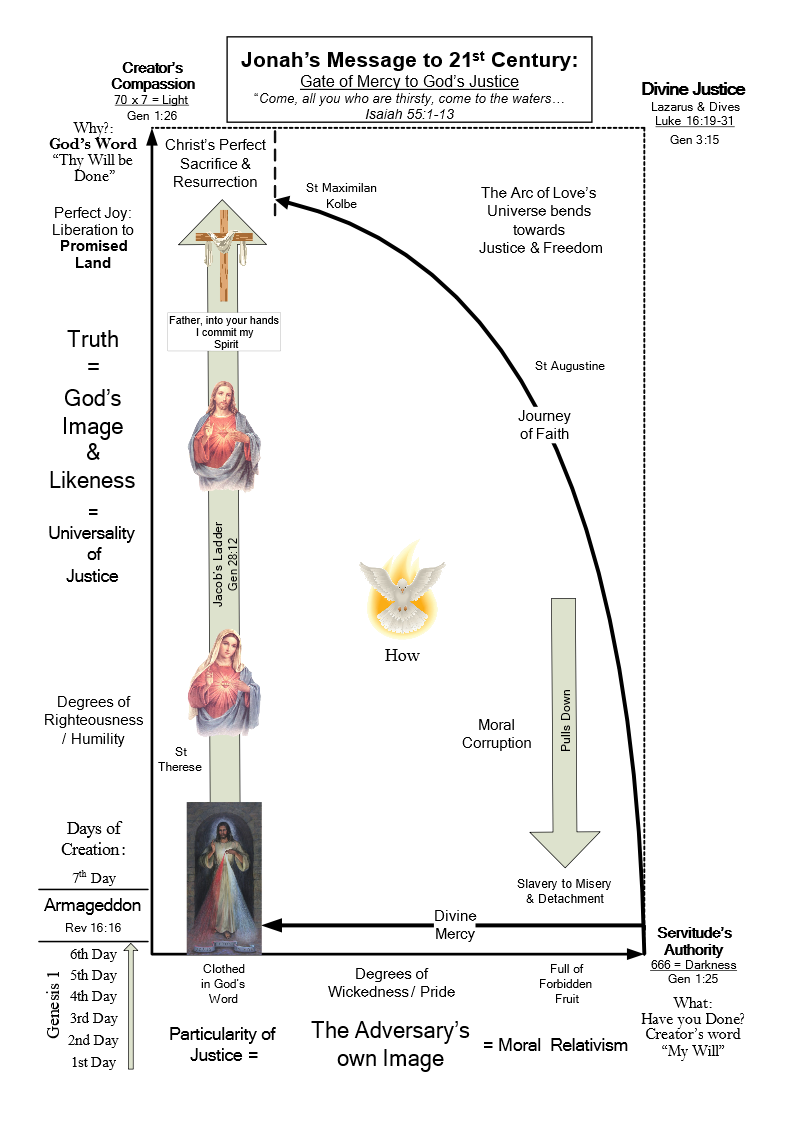
This blog is to commemorate Saints and the saintly people whose lives have been a living testament to Pontius Pilate’s enquiry into Our Lord’s mission “What is Truth?” The site’s patron is St Therese of Lisieux, the Little Flower and her autobiography “Story of a Soul” is its inspiration that has led me towards becoming, living and worshiping as a Catholic. The name a hybrid of the two crowns offered to St Maximilian Kolbe, Sophie Scholl's White Rose Society and the Little Flower.
Friday, 29 January 2016
Wednesday, 6 August 2014
Original Justice according to Saints and Princes
Original Justice:
To
theologians Original justice is defined as the human condition before original
sin destroyed the perfect harmony, between creature and Creator, between man
and woman, as well as the first human couple and all of creation.
Adam and Eve held a special
participation and esteemed place in the earthly paradise of the Garden of Eden.
The glue that held this utopian harmony together was God’s intimacy. Without
this, creation was left in disorder, confusion and a finite existence.
This
is all well established theology in the Catechism of the Catholic Church.
However, is it feasible to assume these principles that form the history of
humanity, can possibly explain the very worst of human behaviour as well as the
very best? To be more precise the inexplicable ideologies of hate like Racism
and anti-Semitism to the more mild symptoms of narcissism, all with the innate
capacity to cause violence and murder to the innocent!
The
faith of the faithful, whom are often martyred by hate regimes, hold the Word
of God in the highest esteem. The Bible is a means of living our lives in a way
that leads to being with God in spirit. Therefore, if occurrences and events of
human history can be explained using sound faith and reason prescribed by Holy
Scripture, then religion could be viewed as a means not a end to moral justice.
Human Nature:
All
the evil in the world is caused by Original sin. Adam and Eve committed a
personal sin, but this sin affected our human nature. Sin propagates
all mankind within every person’s nature. A nature deprived of its original
holiness and justice.
The
universality of the book of Genesis tells us that Adam and Eve were given
dominion over creation, to tend and nurture it. Undoubtedly that this grace was
initially given as a sign of great love for man and woman made in His own image
and likeness. But original sin severed this special bond, for God to remove
Himself from tending to our needs and wants. By breaching this Original justice
humanity is sentenced with affliction throughout their mortal lives. Although,
Genesis describes the effects on body and creation, the book of Revelation
mentions the curse to our souls when chapter 12:17 states: “Then the
dragon was angry with the woman, and went off to make war on the rest of her
offspring, on those who keep the commandments of God and bear testimony to
Jesus.”
So how does this affect our day to day lives?
The Cain Effect:
Cain’s
relationship with his brother manifests how this love for God, hatred of
sanctity, collides. Often in pain and suffering, and even death. After
God favours Abel’s offering, Cain tricks his only brother to go to a remote
place where he slays him in apparent rage of envy. God confronts Cain, like He
did with Adam, “What have you done?” Cain responds with a question “I
do not know, am I my brother’s keeper?” God punishes Cain and in time
answers the question through His only Son Jesus Christ.
What
is particularly telling from the wrongdoer’s response is their sense of
justice! that implies 'Am I not entitled innocence!' The serpent lied to Eve in
the Garden when he said your eyes will be opened and you will be like
gods. Trick them to believe that a new level of privilege and status
amongst all creation is possible if you only break God's commandment. At Babel
their descendants attempted to realise this pledge in exile in the wilderness,
but is refuted by the true God.
One can
draw the conclusion that this tainted special relationship in the eyes of the
Almighty encompasses having the perception of not being able to do no wrong! Cain murders his younger brother because his mentality is in a state of extreme privilege.
God loves
mankind to such an extent that our nature is spoilt by entitlement. And God
empowers his highest ranked archangel to such a degree that he becomes jealous
of his competition, mankind.
God
doesn't take anything away from this state of original justice as punishment.
Consequently, Cain displays the first narcissistic tendency as a murderer of his male sibling of righteousness.
Leading to Babel where his descendants signal their unrighteous intentions.
The Babel Effect:
The story
of Babel highlights man’s desire to find eternal harmony in the kingdom of
Heaven, by using his own means and will. Genesis chapter 11 says “the whole
earth had one language and few words”. They appeared to operate on a belief
of if superior creatures from space ever visited earth, the first question they
will ask, in order to assess the level of civilisation, is “Have you built a
city and a tower to reach the heavens yet?” So God comes down from heaven.
He saw what was afoot and caused them such bewilderment that they dispersed
leaving their self-esteemed plans incomplete. The path to power and glory is
thwarted through confusion.
The
key to the mystery of Babel is in the word ‘language’. To read the
passage in the context of “language of faith in man”, the errors of
man’s ways are revealed. Reassuringly, when God finds a problem He
goes on to provide a solution! The remedy to Babel in particular is religion
and the Church, established in the Upper room at Pentecost (Act 2:1-7).
Light
begins to shine in the darkness of confusion, as the language of faith in
God embodied through the Holy Spirit is poured out (ccc.239). Acts 2:1-6).
This
is why sins against the Holy Spirit (Mark 3:29) cannot be
forgiven because it represents an affront of the will of God and hence forms
a crime against natural justice. Crimes like Racism, Anti-Semitism, and other
ideologies of based on hatred and the lie.
The
universality of natural justice is established when Jesus defeats death on the
Cross with love and obedience of God’s will.
Original Justice according to a Saint:
This
perspective is summed up in a sentence by one of the greatest saints to serve
the Church;
"All
our justice is stained in Your eyes. I wish, then, to be clothed in Your own Justice
and to receive from Your Love the eternal possession of Yourself.
I want no other Throne, no other Crown but You, my Beloved!"
St Therese
of the Child Jesus and the Holy Face.
Original Justice according to a
Narcissist:
To a
narcissist the senses of reality, collectively are rooted within 'Original'
justice and distorted in original sin, indicative of the actions of Cain
and possess all the ambition of the peoples of Babel. Niccolò Machiavelli's book "The Prince" is an insightful example of a Cain-like attitude to your neighbour and the other in realms of politics and business.
The disorder of a Narcissistic Personality involves arrogant behavior, a lack of empathy for other people, and a need for admiration-all of which must be consistently evident at work and in relationships. People who are narcissistic are frequently described as cocky, self-centered, manipulative, and demanding. Narcissists may concentrate on unlikely personal outcomes (e.g., fame) and may be convinced that they deserve special treatment. Related Personality Disorders: Antisocial, Borderline, Histrionic. Narcissism is a less extreme version of Narcissistic Personality Disorder. Narcissism involves cockiness, manipulativeness, selfishness, power motives, and vanity-a love of mirrors. Related personality traits include: Psychopathy, Machiavellianism.
Narcissists tend to have high self-esteem. However, narcissism is not the same thing as self-esteem; people who have high self-esteem are often humble, whereas narcissists rarely are. It was once thought that narcissists have high self-esteem on the surface, but deep down they are insecure. However, the latest evidence indicates that narcissists are actually secure or grandiose at both levels. Onlookers may infer that insecurity is there because narcissists tend to be defensive when their self-esteem is threatened (e.g., being ridiculed); narcissists can be aggressive. The sometimes dangerous lifestyle may more generally reflect sensation-seeking or impulsivity (e.g. bullying, risky sex, bold financial decisions).
The most
distinct feature of a soul remote from God is their belief of ownership of
creation and denial of the Creator as opposed to the Faithful who are servants
of God’s will. Particular examples are the principles of Communism and of
Pharaoh’s refusal to let the Israelites have freedom (Exodus 4:21).
Their
hearts are cold and hardened to emotion. Power and authority is
their heart's desire.
The
events of the holocaust demonstrates such a psyche and thirst for a
warped sense of justice that serves the sinners whim for power, wealth and
discrimination to the detriment of the presumed inferior.
Conclusion:
The
misconception of the impact of Original Sin upon humanity I feel is a major
oversight by theologians and philosophers. Wars, conflicts, discrimination and
ideologies of hated are self-evident reminders of as our Lord describes the
phenomenon as the bursting of “old wineskins”. Genesis 3:21 describes our first parents being clothed in animal fur to cover their exposed and rebellious indignation.
Jesus
Christ becomes our new wineskin that holds both old and new wine (Matt
9:16-17) produced from fruits in God’s vineyard (Luke 20:9-19).
As we
celebrate the feast of the Transfiguration we consider the new cloak of
He who is Justice itself. Who radiates the magnificent splendour and
glory of “the Man” made in God’s image and likeness (Luke 9:29). The
"Cornerstone" of all creation, and it's journey toward our beloved destiny.Wednesday, 15 January 2014
‘Just’ What Authority does the ‘Good Samaritan’ have to Save us? ...All!
Prologue:
The
popular parable of the Good Samaritan [Luke 10:25-36] highlights the Christian
view on kindness towards fellow man or woman in their time of need. However,
could this inconspicuous narrative reveal a much fuller meaning of salvation?
First let’s set the framework for this reflection. Man cannot save himself! [Luke 23:39] To
be saved must be ordained from the Almighty, God the Father.
Psalm 37:39 says “The salvation of the righteous comes from the Lord; he is their stronghold
in time of trouble.”
Salvation’s History (refer to Outline Charts below);
It
all starts from a certain cry:
A voice cries!: “In the
wilderness prepare the way of the Lord, make straight in the desert a highway
for our God. Every valley shall be lifted up, and every mountain and hill be
made low; the uneven ground shall become level, and the rough places a plain.
And the glory of the Lord shall be revealed, and all flesh shall see it
together, for the mouth of the Lord has spoken”. Isaiah 40:3-5; Matt 3:2
Basic Premise: The path of salvation commences with the
cry of Abel the Just for Justice;
and ends with the cry of Jesus for compassion.
Evolution of Salvation History: Battle for Justice
The
prophecy God pronounces in Genesis 3:15 “I
will put enmity between you and the woman and between your offspring and hers”.
In the end good and evil will be judged then will be separated (Matt 25:31-34).
If we fulfil God’s commandments as the Good Samaritan duly did then we will be
saved. Therefore it is reasonable to assume that the offspring of the woman can
be defined by the parable’s message. We know that the ‘woman’ cannot be Eve
(Gen 2:23), but a ‘woman’ born again by the powers used in Genesis to form the
earth in the beginning. Thereby the basis of this theological account is to
show a pattern of how as man through Cain forced God away from himself, God commenced to lay the
seed that would bring him back, for 'our hearts are restless until they rest in thee' (Matt.11:28, Isa.28:12).
After
Abel was slain for being righteous and his blood cried out from the ground (Gen
4:10). God commences on a spiritual journey to defeat man’s sinfulness and to
bring him back to perfection. From the ‘Great Flood’, Noah and his family, Righteousness (Gen 6:9) has strived be
victorious over unrighteousness. The parable can be viewed as an outline of how
to live righteously. Moses and Jesus lead the people as Holy Scripture states
in victories of both the mortal (bodily) and immortal (spiritual) aspects of
mankind. With God’s plan of salvation then fulfilled, we have an opportunity to
accept God’s offer to be saved. For those who wish with all their hearts to
enter paradise must do so by changing their heart, in a fashion like the “penitent thief” on his cross (Luke
23:42-43). The merits of salvation are surely found not so much in the literal meaning
of God’s commandments, but how they are served in the heart, spiritually.
The
Hebrew Bible tells us of how God’s people, Abraham’s descendants, struggle serve
the Lord as slave in Eygpt. God therefore commands Moses to lead them to exile
into the wilderness, to find a promise land of milk and honey. The power of God
is used to guide and protect the Israelites, who carry the seed of
righteousness in blood and faith. Jericho
represents a fortified city of sin, symbolically housing the serpent’s
descendants, signifying the dominion on earth that had to be destroyed to enter
the Promised Land.
After
the miraculous and decisive victory, God tells Joshua of his oath. His proclamation indicates that
this event is a major milestone in history of salvation over man’s mortality.
For the city to raise again that cursed man would have to pay the price God had
paid in Adam and Abel. The new city God establishes is at the price of His only
begotten Son (refer to Table 6.)
The
next phase was to defeat sin spiritually began with birth of the Blessed Virgin
Mary. Consequently Jesus’ mission starts at the wedding feast at Cana, when he
produced his first miracle of changing water into wine. John the Baptist
prepares his path by calling people to repentance and renewal. To be baptised is
a personal ‘fiat’ in the name of God, in the wilderness in the river Jordan.
Jesus
has immense compassion treats the faithful as friends not servants (John 15:15; 2 Chron 20:7; Isaiah 41:8), is a
blessing to others (Matt 11:4-6) and teaches the ways of God the Father. His
mission is fulfilled with his death on the Cross and the giving up of his
spirit into His Father’s hands. His Resurrection
merits the creation of a new heaven and a new earth for the righteous to
prosper for all eternity.
God’s
authority to create and destroy according to His will, accomplishes a new
beginning where everything is made new again (Rev 21:5). The nation of Israel’s
active participation was plainly crucial to accomplish this decisive victory
for all eternity; allowing for our own free-will to work together in
righteousness to save souls by obeying God’s will through faith and good works.
“Not my will, but your will be done.”
The
parable of the Good Samaritan (Luke 10:26-37) describes how salvation
is merited. That is by tending to the needs of your neighbour who is mortally
wounded whilst travelling to Jericho. If we interpret this journey in the
context of the Book of Joshua, then they are akin to a faithful Israelite on
their way to destroy the city of sin, a pilgrimage for righteousness sake.
Hence, assume that the journey is one of faithful sanctification, validating
the primary commandments of devotion to serving God’s cause for our lives.
We
can look upon the fallen victim as being in a mortally wounded state caused by sin and
the effects of sinners or robbers. Whose intention is to deprive God the joy of
being united with his creation made in his image. It is useful also to view
Christ’s journey to Jericho as suffering the same fate, left mortally dead on
the Cross.
The
Robbers are the wicked sinners, the
unrighteous who use what limited authority they have with violence, to tempted,
demoralise and ensnare their victims to fall into being dispossessed of their
virtue and innocence, namely their dignity endowed by God.
The
passersby represent the
self-righteous, who are cold-hearted (Matt 3:7-8) and tepid, although
faithfully travel towards Jericho with good intentions, fail to serve justly,
having a subjective, and inward-looking form of sanctification.
The
Good Samaritan, are the righteous,
who faithfully serve God’s commandments, with full divine authority to heal and
inspire them to persevere on the right path. There are three persons who justly fulfil
this virtuous role. Firstly, God the Father, who receives his only, begotten
Son upon the resurrection. After which Christ’s authority is used to establish
his Church, to cleanse our own sins, in the form of oil and wine for anointing
and redemption by the precious Blood. Lastly, the faithful who are tasked imitate
God to tend to our neighbours sins using his grace merited on the Cross. Thereby achieving due unity
and oneness with God, in a similar affiliation as Adam was with Eve (Gen 2:24).
Excellent examples that demonstrate this point are the Jewish mitzvot and
Mother Teresa’s missionaries in serving the poor. This person is true to their
responsibility as an active steward in a civilised society crying to be blessed
with prosperity.
The
Innkeeper represents the Church
(ccc.1465) as distributors of the sacraments that allows grace to heal within the
house of the Lord. Also to act with responsibility as servants to those in spiritual need,
particularly the poor and a basis for evangelisation of the 'Good News'!
Payment for services rendered (Luke 10:35) presently
and at the end of Time, when you will be judged according to the likeness of
Christ’s heart for God and his neighbour (1 John 2:29). Two Denarii was given
for the present. This is translated to; a few days lodgings in societal terms; Jesus’
Body and Blood (Matt 26:26-29) in our Saviours terms and a new Heaven and Earth
in God the Father’s Kingdom (Rev 21:1).
Subsequently when viewed in
this light main points can be noted which increase our merit of being saved.
These are:
·
Journey
to Jericho is a pilgrimage to become sanctified before God;
· Our
neighbour is anyone who requires help to live a more holy life and journey towards sanctification;
· The
Good Samaritan seeks to assist the sinner to be more righteous by using moral
support or encouraging them to be an active within the Church and evangelising
the faith.
· The
innkeeper’s are spiritual physicians addressing all wounds from sin applying the
Church's doctrine.
· Another
benefit of the parable is to define what constitutes virtue. As, are we not
tasked to use the gifts given by God as we consider suitable, to satisfying his Will.
Biblical
References supporting Theme:
Comparable themes between Hebrew & Christian
Bibles
|
||||
Nos.
|
Mortal
Victory - Hebrew
|
Immortal
Victory – Christianity
|
||
1
|
A call for Israelites to follow
|
Isaiah 40:3-5
|
A call for Nations to repentance
|
Matt 3:2
|
2
|
The angel’s sword.
|
Josh 5:13
|
Christ’s sword of Judgement
|
Rev. 2:16
|
3
|
Ark of the Covenant
|
Josh 6:6
|
Virgin Mary, Mother of God, Ark of the New Covenant
|
Luke 1:35; Rev 12:5-6; CCC. 2676
|
4
|
7 days encircling Jericho
|
Josh 6:3-4
|
7 days of Creation
|
Gen. 1;2:1-3
|
5
|
City of Sin Destruction
|
Josh 6:17
|
New Heaven & Earth
|
Rev. 21:1-8
|
6
|
Oath: Cursed be the man who builds a new Jericho, paying the price of
his first born & youngest son.
|
Josh 6:26
|
Cost of the new city of Holiest was His only begotten Son.
|
Matt 3:17; Gen 4:10-11
|
7
|
Jerusalem
|
Zech 8:3
|
New Jerusalem
|
Rev 21:9-27
|
8
|
Render True Judgment
|
Zech 7:9-10
|
Sheep will be separated to Goats
|
Matt 25:31-46
|
Conclusion:
This
more objective interpretation of this parable highlights how salvation can be
viewed more fully as well as more practically. The emphasis being that love is
best expressed with action. Not merely to be loved but to love.
Christ
completed mission reflects the righteousness, pleasing to God the Father.
Therefore ‘to do likewise’ (Luke 10:37) we can be assured to imitate
perfection, the kind that saves us all!
History
is full of man’s victories and catastrophes forming the rise and fall of
nations, races and empires. Life is full of people who seek military solutions.
Yet the ‘meaning of life’ remains elusive or vague to those outside organised religions.
I hope that this earnest attempt to depict the means of salvation in a more
coherent way, serves to boost the faith and encourage peaceful relations
between not only Judeo-Christian religions, but also all Abrahamic-based
faiths.
To
succeed in serving your neighbour in the true sense, “Fraternity” is very much
at the heart of all relationships we encounter each and every day.
‘Whoever does not love does not know God,
because God is love’. 1
John 4:8.
Wednesday, 29 May 2013
The Bible’s "Tale of Two Cities" narrated by St Augustine

On my third
Ignatius retreat in so many years, I received an epiphany, the type that changes
your life and deepens your faith in the Almighty God. After attending a Catechist course at
the Maryvale Institute, Birmingham I was introduced to portraying the teachings
of the Catholic Church in various ways in order to
evangelise more effectively. I combined this with a Business Analyst skillset and lots of prayer and fruit began to bloom in a number of ways.
A few years ago I was able to express pictorially my
understanding of salvation (shown above). However, I had arrived at a point where I was
unsure as to how to develop the presentation further to obtain a better more fuller understanding. Sure I tried to
support its contents with Sacred Scripture; but I knew that there was much
more to unravel.
Last year I was very fortunate to go on Pilgrimage to
Medjugorje before partaking on the Ignatius retreat that was held in the
idyllic countryside of France. Then in a moment of inspiration I asked one of the
Benedictine monk conducting the spiritual exercises “What book should I read to better understand society and the world at
large?”
His answer at the time was received with a little
disappointment as I considered the Church’s fore-Fathers as dare I say it abit old
fashioned! I should of known better in that St Augustine’s “City of God” was the perfect answer to
my spiritual quandary. So much so that you would think the noble Saint had used
the illustration as a theme to his literary work. Explaining at length the fall
and rise through Christ of mankind. The only aspect not covered is the conflict
for souls to be saved (the middle section). Perhaps there is another book(s) which serves this purpose,
either published or to be published? Or maybe this is just a matter of devotion
to the Virgin Mary and the Divine Mercy to accomplish its
more practical aspects.
In the 5thCentury St Augustine wrote the “City of God” as a Bishop, to present a
sound argument for Catholic Church’s position on the following key topics:
+ Clarify
that Christianity was not to blame for the fall of the Roman Empire;
+ Reveal
that even the most evil actions of fallen angels and sinful man cannot thwart
the unfolding of God’s eternal plan;
+ Propose
that the fall of the Roman Empire was insignificant in the context of the
eternal plan of God;
+ Describe
the choice we must all make choose to occupy either the City of God or the City
of Earth the consequence of which is eternal.
In
contemporary terms I have tried to categorise these differences between the Cities of
God and of man outlined in the book in the following grid. Consequently this also can provides interpretation and better insight as to what
Jesus was referring to, when He spoke about division in the book of Luke:
“I came to cast fire upon the earth; and would that it were already blazing! [with the Holy Spirit] Do you suppose that I came to grant peace on earth? I tell you, no, but rather Division” - Luke 12:49-51; CCC.696.
Theme for reflection therefore is: How
should we view this division?
Table of Division |
||
From God
|
Classification
–
Mark 11:30
|
From Men
|
Heavenly City - CCC.1045
|
St
Augustine
Book
“City of God”
|
Earthly City – CCC. 2124
|
Moral authority
|
Institution
|
Immoral authority
|
Walk in the Spirit
|
Nature
of Journey
|
Walk in the Flesh
|
The Natural Law –CCC.1954-60
|
Legislation
|
Law of the Land
|
Good Shepherds
- Moses, Jesus
|
Leadership
|
Dictators - Hitler
|
Treasures in Heaven
|
Wealth
- Matt 6:19-21
|
Earthly Treasures
|
Democracy
|
Governance
|
Slavery, Captivity
|
Truth
|
Values
& Principles
|
Lies
|
Servant
|
Character
|
Betrayer
|
Humility, Evangelisation
|
Mindset
|
Power, manipulation
|
Love, Compassion,
Supportive
|
Language
|
Hate, Envy, Jealously
|
Peace
|
Disposition
|
Anger
|
Brother’s Keeper
|
Interests
|
Murder & Pillage
|
Forgiveness, Merciful
|
Attitude
towards Neighbour
|
Accusation, Condemnation
|
The “City of God” consists of 22 books; each described briefly as follows:
Summary:
In effect, The City of God is a
challenge to human society to choose which city it wishes to be a part of, and
Augustine sees his task as clearly marking out the parameters of each choice.
Augustine concludes that the purpose of history is to show the unfolding of
God’s plan, which involves fostering the City of Heaven and filling it with
worthy citizens. For this purpose, God initiated all of creation itself. In
such a grand plan, the fall of Rome is insignificant.
Book 22 This book treats of the end of
the city of God, that is to say, of the eternal happiness of the saints; the
faith of the resurrection of the body is established and explained; and the
work concludes by showing how the saints, clothed in immortal and spiritual
bodies, shall be employed.
Subscribe to:
Posts (Atom)