Follow by Email

Wednesday, 17 April 2013

In Times of Trouble and Strife; in Life or Death; Love transcends all!


For all the respectful adoration or vehement animosity aimed at Baroness Lady Margaret Thatcher’s legacy. To me she was an inspiration in my life as was I am sure the case for many others like me. With passion and utter vigour she, in her own way, encouraged people to do something with their lives. She was a pioneer of the “yes [you] can” ethos. Her leadership style of strength and conviction created a landscape for people to pursue something better! One of optimism and hope! Just get up and do it! This is quite meaningful when viewed from the perspective of religion, as Baroness Thatcher was a committed Christian of the Methodist denomination, a person of loyal faith.
 
However, her weakness in hindsight was that the ‘you’ should have been ‘we’! A point not lost on the Obama Administration I might add. It is debateable that more emphasis on the 'Common Good' and particularly compassion towards thy neighbour rather than own personal wealth and standing, to be more selfless than selfish. Would maybe have mitigated the level of resentment and universally increased condolences. Nevertheless her accomplishments were staggeringly commendable by any measure.
Therefore as the historians start to establish her legacy, I contemplate the extent to which her passion in the life of politics was a case of ‘my will’ or ‘Thy will’? (In reference to Jesus in the Garden of Gethsemane; Luke 22:42). She also was double-crossed in the end when she was forced to step down from office as Prime Minister, after being betrayed by some of her closest friends and colleagues.
The sense of loss is something everyone one has to endure to various degrees in our lives. However, as Christians and religious depending on how we answer this choice of duty we can look upon our own loss as God’s gain, by providing Him with an opportunity to make us complete again. In a similar way he brought Our Lord back from the dead to life everlasting. So we mustn’t waste these opportunities by allowing loss to corrode our souls with bouts of hatred, rather to cherish them by relying on our faith in the victory of righteousness over wickedness. And that God will always meet our every need, through His ever giving and everlasting providence.  
The following is an excerpt from the books “The Story of a Soul – Study Edition [Commentary Notes - Marc Foley O.C.D.]” – by St Therese of Lisieux and “The Search for Meaning” by Dr Victor Frankl; which collectively puts life and death into a thought provoking perspective that illustrates why love will always conquer hate.
The former is an autobiography of a cloistered nun who Pope Pius X proclaimed the “Greatest Saint of modern times” after enduring many sufferings in her life. She died an agonising death of tuberculosis at the tender age of 24. The latter being a Jewish psychiatrist and Auschwitz survivor who wrote a thesis on his experience in the death camps of WWII.
As Therese recounts the time that she stood before her mother’s coffin, the memory of standing before Mother Genevieve’s [Carmel’s Mother Prioress] coffin come to her mind, she reflects upon the vast difference between the two experiences. As a four year old child who had just lost her mother, the coffin “appeared large and dismal”. In contrast, as an adult, who had “grown up…the coffin appeared smaller…[and now, the reality of death, seen through faith, was an occasion] to contemplate heaven”. As Therese looks back upon her four year old self, who had been shattered by the death of her mother, she stands in amazement that she has survived this loss. “All my trials had come to an end and the winter of my soul had passed on”.
Like Therese, there are moments when we take a backward glance upon our lives and stand in amazement that we were able to survive a devastating loss. “Black grief closed over my heart,” wrote St Augustine on the death of a friend. “Everything I had shared with my friend turned into hideous anguish without him. My eyes sought him everywhere, but he was missing; I hated all things because they held him not…All this is over now, Lord and my hurt has been assuaged with time.”
Like Therese and Augustine, all of us have experienced losses, which at the time; we felt that we did not have the strength to bear. For when we are overwhelmed with black grief, it is beyond the power of imagination to believe that the winter of our soul will ever pass. Therese experienced time’s healing hand as she cast a backwards glance upon her mother’s death, but she experienced something else, the faith that pierces the dark veil of death. “I had no need to raise my head to see and, in fact, no longer raised it but to contemplate heaven which to me was filled with joy”.
In less than a year after Therese had penned these words, the thought of heaven would not fill her soul with joy but with anguish. During her night of faith, when she doubted the existence of heaven, she wrote, “that the thought of heaven, up until then so sweet to me, was no longer anything but the cause of struggle and torment”. Yet, in the midst of her darkness, when she felt that she lived “in a country that is covered with thick fog”, God’s light would periodically “shine through even in the midst of the darkest storm…[and for a brief moment] heaven was a calm and serene and I believed I felt there was a heaven and that this heaven is peopled with souls who actually love me, who consider me their child”. Therese is describing an experience of God’s love that pierces through our pain during times of our deepest darkness and for a moment, we know that love is eternal.
On a cold winter morning, as he and his fellow inmates were marching to their work site in Auschwitz, Vickor Frankl had such an experience.
We stumbled on in the darkness, over big stones and through large puddles, along the road leading from the camp. The accompanying guards kept shouting at us and driving us with the butts of their rifles. Anyone with very sore feet supported himself on his neighbour’s arm. Hardly a word was spoken; the icy wind did not encourage talk. Hiding his mouth behind his upturned collar, the man marching next to me whispered suddenly:
“If our wives could see us now! I do hope they are better off in their camps and don’t know what is happening to us.”
That brought thoughts of my own wife to mind. And as we stumbled on for miles, slipping on icy spots, supporting each other and again, dragging one another up and onward, nothing was said, but we both knew: each of us was thinking of his wife. Occasionally I looked at the sky, where the stars were fading and the pink light of the morning was beginning to spread behind a dark bank of clouds. But my mind clung to my wife’s image, imaging it with an uncanny acuteness. I heard her answering me, saw her smile, her frank and encouraging look. Real or not, her look was then more luminous than the sun which was beginning to rise.
A thought transfixed me: for the first time in my life I saw the truth as it is set into song by so many poets, proclaimed as final wisdom by so many thinkers. The truth – that love is ultimate and highest goal to which man can achieve. Then I grasped the meaning of the greatest secret that human poetry and human thought and belief have to impart: The salvation of man is through love and in love. I understood how a man who has nothing left in this world still may know this bliss, be it only for a brief moment in the contemplation of his beloved. In a position of utter desolation...for the first time in my life I was able to understand the meaning of the words, “The angels are lost in perpetual contemplation of an infinite glory.”
I sensed my spirit piercing through the enveloping gloom. I felt it transcend that hopeless, meaningless world. At that moment a light was lit in a distant farmhouse, which stood on the horizon as if painted there, in the midst of the miserable grey of a dawning morning of Bavaria. “Ex lus in tenebris lucet” and the light shineth in the darkness.”
Baroness Margaret Thatcher RIP.


Tuesday, 28 August 2012

Meditation for the Feast of St Augustine of Hippo


What the Scribes and Pharisees Needed


Let us lead good lives, and while we lead good lives let us on no account take it for granted that we are without sin. Living a life that is praiseworthy includes begging pardon for things that are blameworthy. But people who are beyond hope pay all the less attention to their own sins, they are more interested in those of others. They are looking for a chance to tear others to bits, not to put them right. Unable to excuse themselves, they are only too ready to accuse others.
Sin cannot possibly go unpunished.  The forces of nature become imbalanced, unstable and unsustainable. If a sin remains unpunished it is naturally unjust, and so undoubtedly it must be punished. This is what your God says to you: “Your sin is punished, either by man repenting or by God judging”. So either it, without you, it is punished by you or else it together with you is punished by God. What is repentance after all, but being angry with oneself? What’s the idea of beating your breast if you aren’t just pretending? Why beat it if you aren’t angry with it? So when you beat your breast you are being angry with your heart in order to make amends to your Lord. This is also how we can understand the text ‘Be angry and do not sin’. Be angry because you have sinned, and by punishing yourself stop sinning. Give your heart a shaking by repentance, and this will be a sacrifice to God.

Saint Augustine of Hippo – Doctor of Grace
Extract from "Magnificat" - August 2012. Vol 2 No11

“He cannot have God for his Father who will not have the Church for his mother.” - St. Augustine

“This is the sum of religion, to imitate whom you worship” - St. Augustine


Monday, 27 August 2012

St Monica - A Mother of Faith, Prayer and a Giant of the Church

 
Reading St Augustine’s “City of God” for practical reasons, I look upon the feast day of St Monica as a day of thanksgiving. The Church has benefited so profoundly from the fruits of her endeavours, expressed through St Augustine, her son. She is a befitting example of the power of prayer and faith by way of virtues.
Her life story is an example of the importance of family bonds and the responsibilities of the parents in regarding their children as “children of God” (CCC 222). I am quite sure that the secret of St Augustine’s greatness was the holiness of his doting mother St Monica. I know “Little Therese” (St Therese) whom I view in very high regard, came from a very pious family, for her mother and father Blessed Louis and Zelie Martin were beatified in October, 2008.

I am reminded of the commentary from the excellent book I read a few years ago “The Story of a Family – The Home of St Therese of Lisieux”. Which said; “Giants in any sphere of human endeavour stand on the shoulders of giants. Nobody gets to heaven alone. We are all what our birth, our families, our education, our country, etc. Have helped to make us”.
Short commentary and pertaining Verses of Scripture:
·        The purpose of Christian faith is to view it as a seed you nurture and growth both interiorly and exteriorly: “Still other seed fell on good soil. It came up, grew and produced a crop, some multiplying thirty, some sixty, some a hundred times.” Mark 4:8.

·        Always believe in miracles and desire to do God’s will. St Therese so eloquently stated in her oblation “’Whatsoever you ask the Father in my name he will give it to you!’ I am certain, then, that you will grant my desires, I know, O my God! That the more you want to give, the more you make us desire...”“Truly I tell you, if you have faith and do not doubt, not only can you do what was done to the fig tree, but also you can say to this mountain, ‘Go, throw yourself into the sea,’ and it will be done. If you believe, you will receive whatever you ask for in prayer.” Matthew 21:21-22

St Monica’s biography from “Catholic Online”.
St. Monica was married by arrangement to a pagan official in North Africa, who was much older than she, and although generous, was also violent tempered. His mother Lived with them and was equally difficult, which proved a constant challenge to St. Monica. She had three children; Augustine, Navigius, and Perpetua. Through her patience and prayers, she was able to convert her husband and his mother to the Catholic faith in 370• He died a year later. Perpetua and Navigius entered the religious Life. St. Augustine was much more difficult, as she had to pray for him for 17 years, begging the prayers of priests who, for a while, tried to avoid her because of her persistence at this seemingly hopeless endeavor. One priest did console her by saying, "it is not possible that the son of so many tears should perish." This thought, coupled with a vision that she had received strengthened her. St. Augustine was baptized by St. Ambrose in 387. St. Monica died later that same year, on the way back to Africa from Rome in the Italian town of Ostia.


Tuesday, 14 August 2012

St Maximilian Kolbe Pray For Us All !


I have come....to proclaim the Truth. Everyone who is of the Truth hears my voice. Pilate questions, "What is Truth?” (John 18:37-38).
Happy Feast day! St Maximilian Kolbe, the Patron Saint of Difficult Times.
His life and death is an excellent testament to the Truth, proclaiming the embodiment of Christianity in its purest form. 
The following points are as to why I believe in regards particularly to St Maximilian Kolbe’s life this is very much the case. For he...
·       ...proclaimed the “Good News” of Christ through the devotion of his mother, the Blessed Virgin, entirely throughout his life. Using media technology at the time and ministry to spread the truth of God’s word in the most far-off reaches of the world, like Japan (Matt 28:19-20);
·       ...spread the joy of the Truth by raising his friends and acquaintances spirits when the world or trial was getting them down (Matt 25:21).
·       ...in living he loved, to the extent of giving his all including himself, for God and his neighbour (Matt 22:39).
·       ...showed compassion to his enemies and prayed to the great Mother of God. For the sinless to save the sinful, by asking the Virgin Mary for their hearts to softened and become converted by granting them the gift of faith to appreciate the Truth (Luke 6:27-31) ;
·       ...lived a life as an exemplary example of a child of God in humility and charity, by accepting completely our Mother’s “fiat” (“so be it” Luke 1:38), offered to him by way of two crowns one white for chastity the other red for martyrdom, in doing so he embraced our Lord’s passion and will quite devoutly (CCC 494). Thus obtaining prestigious entitlement from God’s first promise of righteousness conquering evil (Gen 3:15);
The Book of Revelation 20:4-6 provides a revealing validation as to why St Maximilian’s life of Christ is extremely important for everyone to hear all over the globe. Because in divine terms it describes what God’s Judgement of a soul’s destiny means separated between heaven, purgatory and hell. From Christ’s first resurrection to His Second Coming where body is reunited with soul. It is the very reason why we should emulate this example and similar others like St Therese for instance, in our own lives, but especially for bloggers!
This is a pertinent theological explanation by Matthew Henry's Concise Commentary
“Here is an account of the reign of the saints, for the same space of time as Satan is bound. Those who suffer with Christ, shall reign with him in his spiritual and heavenly kingdom, in conformity to him in his wisdom, righteousness, and holiness: this is called the first resurrection, with which none but those who serve Christ, and suffer for him, shall be favoured. The happiness of these servants of God is declared. None can be blessed but those that are holy; and all that are holy shall be blessed. We know something of what the first death is, and it is very awful; but we know not what this second death is. It must be much more dreadful; it is the death of the soul, eternal separation from God. May we never know what it is: those who have been made partakers of a spiritual resurrection, are saved from the power of the second death. We may expect that a thousand years will follow the destruction of the anti-christian, idolatrous, persecuting powers, during which pure Christianity, in doctrine, worship, and holiness, will be made known over all the earth (bloggers take note). By the all-powerful working of the Holy Spirit, fallen man will be new-created; and faith and holiness will as certainly prevail, as unbelief and unholiness now do. We may easily perceive what a variety of dreadful pains, diseases, and other calamities would cease, if all men were true and consistent Christians. All the evils of public and private contests would be ended, and happiness of every kind largely increased. Every man would try to lighten suffering, instead of adding to the sorrows around him. It is our duty to pray for the promised glorious days, and to do everything in our public and private stations which can prepare for them.”
Meditation Point: “beheaded because of their testimony” or righteousness (Rev 20:4). Is this a reference directly to John the Baptist in the New Testament and indirectly Abel in the Old Testament!?
To the Patron Saint of difficult times, Pray for us!

Sunday, 20 November 2011

To be numbered on the List of "Christ the King" in whom we can Trust!


Today is the feast day of “Christ the King” and last day in the Church’s year. The Scripture readings are on how Jesus as the Good Shepherd” of his sheep judges us at the end of this journey we call our “life” and is consequently an important one to fully appreciate. Here He outlines the fundamental laws upon which our eternity will be determined, in quite stark terms (Matthew 25:31-46).
I believe this message is particularly enhanced when taken with another verse of Scripture that says “He who is not with me is against me, and he who does not gather with me scatters” (Luke 11:23). The crux of the message can be interpreted to mean that our destiny is decided by the contrasting states of our hearts, being either full of compassion for people’s well-being and for social justice or full of contempt for your neighbour’s existence, for more self-centred reasons, e.g. greed.
This is dramatically and objectively symbolised in modern today terms through Thomas Keneally’s book “Schindler’s List” adapted by Steven Spielberg into film, based on historical facts in a period of particular anti-Semitic brutality during World War II.
The cold-blooded hatred by a nation’s community towards its ethnic minorities is disturbingly alarming. This is contrasted with hope beautifully, through the compassion shown by Oscar Schlinder, who eventually repents from his sinful ways and works against his Nazi party’s sinister agenda. When he decides to save as many of God’s chosen people he can by using his power and wealth obtained through political favour to make a difference for the sake of God’s righteousness and not against it.
This point is especially emphasised with the scene where as the Jews in Kraków are forced into the ghetto, a little girl on the street cries out, “Good-bye, Jews,” over and over again. She represents the open hostility often shown the Jews by their countrymen. After all, the little girl did not contain this hatred naturally—she learned it. Through her, Spielberg sends the message that the evil of the “final solution” infected entire communities. This is reinforced by another scene where bystanders knowingly wave at the cattle trains filled with despairing souls as they are mercilessly transported to the death camps to meet their presupposed fate.  
Applying the Gospel verses to this gruesome scenario of injustice presents an irony unknowing to the misguided, is that they might as well be venting their rage and anger upon a mirror! By remaining unrepentant, they take the risk of God turning the table upon themselves and returning the gesture on judgement day for their lack of faith in all that is Goodness and Truth.
Consequently the underlying message given to us on this special day to commemorate Christ's Majesty is that we should constantly cultivate and tend to our hearts with acts of compassion, similar to that of the Good Samaritan (Luke 10:25-37) and only then we will merit the full blessings and promises of God and thus avoid the total loss of His love and mercy we take each day for granted.

Wednesday, 17 August 2011

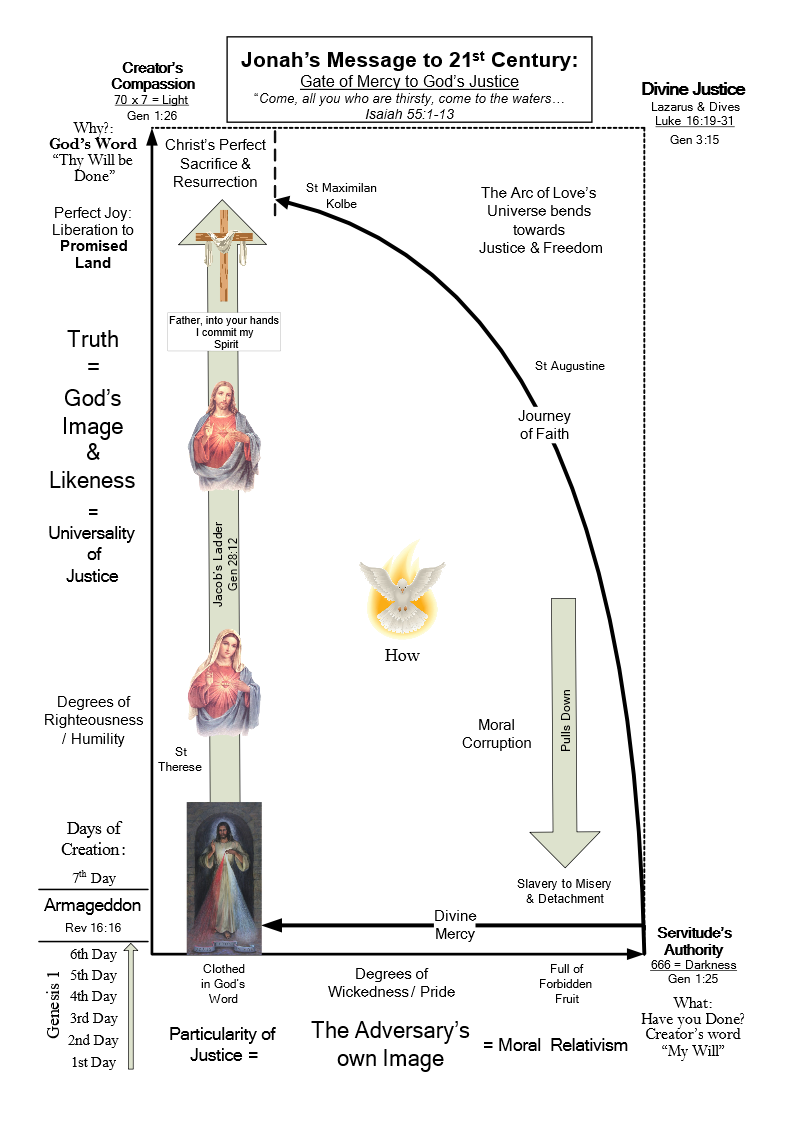
JMJT: Is the “Little Way” a New Genesis or a Revelation!?


First posted by Simon Pickering 21st May, 2010 on 4Marks Social network;

Being a disciple and follower of St Therese of Lisieux this blog portrays “The Little Way” from a new perspective that could help us gauge the enormity and universality of her message!

This question has led me to ponder on the connection between St Therese’s “Little Way” and the Biblical book of “Genesis”, Sacred Scripture’s account on the creation of the whole world. We can be certain that St Therese’s message is substantially embedded in the Gospels but can its roots be traced back to the beginnings of time itself? Because if there is a strong connection between the two accounts of holiness, her reference to “little” should not be deemed in relation our views on littleness, but God’s view!  

St Therese gives us some clues when she mentions “keeping the ’Kings Secrets’ in the bottom of her heart” and “it is honorable to publish the works of the Most High”; also “how powerless I am to express in human language the secrets of heaven”.  Finally she says “There are so many different horizons, so many nuances of infinite variety that only the palette of the Celestial Painter will be able to furnish me after the night of this life with the colors capable of depicting the marvels He reveals to my soul”.  We can therefore surmise that St Therese holds a secret, a very big secret of the magnitude of God’s grace and how we can attain it.

Bible Study notes of the Book of Genesis compared to St Therese’s Little Way;

Chapter 1: The World at its Creation:

The Holy Scriptures;
  • Light sustains life in the world (1:3-4)
  • Adam & Eve’s meekness and simplicity in their state of “Original Holiness or Justice” to serving God’s will is deafeningly silent. It is sufficient only for God to describe them and the scenario as “very good” (1:31).
  • God states that what He saw was “good” seven times in Chapter 1 (1:3,10,12,18,21,25,31); Harmony and perfection presides over all God’s creatures, with Man as their shepherd.
  • Man was made in God’s own image, to shepherd over His creation (1:26).
  • God’s orders His creatures to be fruitful as God intended them to be and fill the world with their presence to quell earthliness (1:28).
The Little Way (LW):
  • Jesus through the Virgin Mary provides the light to our spiritual darkness; Therese promises to shed a shower of roses from Heaven; Charity is a cornerstone of holiness: 
  • Life for all of God’s creatures was straightforward and their task was only to fill the world with their goodness; Glory was only attained through God and not from ourselves:
  • Everything was “good”; the power of goodness cannot be overlooked or underestimated; everything was made and done out of Love of God from His Love; God expects us to do and be good to honor Him in everything we do, no matter how small; Jesus says “Little Children, love one another, as I have loved you” (John 13:34):
  • We are children of God born in His own image, which means we can only feel complete and contented being one with God, by doing His will (e.g. Virgin Mary’s “fiat” and “Thy will be done”); Therese says you need to be little and weak to have habitual fusion with Jesus (refer to Mt 18:4).
  • St Therese’s autobiography “Story of a Soul” fulfills this divine order by bearing fruit from all over the world by using Christ as its vine (John 15:1).
Chapter 2: Adam & Eve (Original Holiness):
The Holy Scriptures;
  • God breathed life into the soil or dust to create Man (2:7):
  • God created a special place for Man called the Garden of Eden, where He created a variety of trees; Central to the Garden were two trees, one of life the other of knowledge between good and evil (2:9).
  • God instructs Man to tender the garden (2:15) but must not touch or eat from the tree of knowledge or else death becomes him (2:16); Note that there is only one condition (commandment) for living in paradise, Man’s original utopia!
  • God sees that Adam’s loneliness and seeks a suitable companion for him (2:18,20).
  • God empowers Adam to name His creatures and authorizes his decision (2:19).
  • God creates a partner for Adam from one of his ribs, so that there can become one together (2:22;24)
  • Adam and Eve were completely shameless and thus were looked upon as perfection in the eyes of God as He intended them to be so (2:25).
The Little Way (LW):
  • God demonstrates the simplicity and power of His grace to create the wonder of life; The LW by design can harness the same breath of divine air that fills our lives with God’s grace as His “Spiritual Children”.
  • God reserves a special place for His people, today we call this salvation in Heaven; LW is a straight path to Jesus Christ who represents the Tree of Life (John 1:23); Life’s simplicity naturally creates harmony and perfection, which draws God’s presence and mercy; Therese loved nature and animals, particularly roses, so she would of loved immensely being in the Garden of Eden and fitting perfectly within this idyllic habitat, without distraction!:
  • God’s commandment became Jesus “He says listen to Him!”(Luke 9:35); LW encourages us to be virtuous to all God’s creation because we are blessed and we should avoid to sin:
  • God provides, as a father for his children, to those who please Him and who rely on Him, even without request or petition, for He knows their needs and He through love will satisfy them;
  • God gives man authority over his kingdom, this is why praying and caring for each other is expected by Him;
  • Zelie and Louis Martin were model parents, as St Therese describes them as “Being more worthy of heaven than of earth”; This I am sure inspired her to understand the natural relationship of people with God:
  • Holy purity and innocence comes from “simplicity” and “spiritual poverty” and not through deeds or accomplishments:
Chapter 3: Original Sin:
The Holy Scriptures;
  • The serpent hoodwinks Adam and Eve and their eyes are opened to understand the difference between good and evil, the effects of disobeying God and eating from the tree of knowledge (3:1-6).
  • They became ashamed and noticed their nakedness covering themselves with plants or fig leaves (3:7).
  • God called for Adam who was in hiding ‘Where are you?’ (3:8). Adam confesses to his state of being to God (3:10). God then accuses him of wrong doing and enquirers as to how they knew that they were naked? (3:11). 
  • God says “What have you done?" indicating the hurt, the grief He felt by the betrayal (3:13)
  • A trial ensues and God discovers the instigator the serpent’s guilt of the three parties He questions (3:12-13);
  • God punishes all parties involved for retribution. The devastating stain of “Original Sin” enters the world. (3:14-19).
  • God said to the condemned Serpent, that his descendants including people in-spirit will always be opposed and yet powerless against God’s people, whom are faithful to Him: (3:15). 
  • God gave man the garments of his fallen nature, so his image on the outside portrayed the skin of an animal or beast (contrary to this verse, Gen 2:20) rather than the image God intended him to have. Indicating that animals were to be sacrificed to cover or pay for man’s sins and to display his demoted status (3:21).
  • Adam & Eve were banished from paradise and eternal life, to survive in the harshness of the wilderness, the price they paid for having the capacity to be Godly, acquired through Original Sin (3:22-24).
The Little Way (LW):
  • LW is obedience simplifies and directs us towards the “Tree of Life”, Jesus Christ, through the Gospels; Jesus tells us “I am the way, the truth and the life, no one comes to the Father except by me”(John 14:6):
  • It is sufficient for us to put our trust and confidence in Our Lord Jesus Christ who doesn’t cover but takes away our sins in the sight of God, the Father:
  • Fear and disunity enters the original parents consciousness so they look for excuses; Their lives in effect becomes complicated and harsh, not simple and peaceful:  
  • What have we done? To show thanksgiving to God’s grace, this in the world means everything!
  • God “Loves the sinner, hates the sin”; God’s is only comforted through our prays and by doing penance for those who offend Him:
  • Therese embraced joyously suffering “I have learned to find joy and sweetness in all that is bitter”(refer to Col. 1:24); By carrying her cross she knew that she was following Jesus and would find Him in all His glory; She also says “Let us offer our sufferings to Jesus for the salvation of souls.”
  • Pray for those who are on the wrong side of this divide between good and bad; Pranzini was Therese’s first child, saved by her intercession; She enters Carmel to fulfill this vocation of saving souls and making Priests saints:
  • We clothe ourselves in Jesus’ wounds who is the Lamb of God who takes away the sins of the world and restores us to our original image, so that God the Father can elevate us back to Him:
  • Humbleness is virtuous and our armor (our combat jacket) which will help us survive the dangers of our spiritual wilderness; Avoiding and being detached from the snares, pride tempts us towards through having knowledge and intellectual status, as being Godly opposes our route to holiness; St Therese teaches us, all that really matters is letting Jesus be your elevator to Heaven; Jesus says “Unless you be converted and become as little children you cannot enter the kingdom of Heaven” (Mt 18:3):
Chapter 4: Cain & Abel:
The Holy Scriptures;
  • Cain a descendant of Adam & Eve, questions God’s favor and fails to understand the consequences of doing what is wrong compared to doing what is right (4:6-7). God’s advises him “you must master it (sin)” (4:7):
  • Cain ignores the advice and kills Abel out of jealousy (4:8):
  • God exclaims “What have you done?” for the second time to man (4:10). Again, God shows His hurt,  His grief and annoyance of what man was doing:
  • Cain struggles with his exposure to the danger and despair of being an outcast from God’s presence (4:14).
  • Cain’s appeal drew sympathy from God and He issued a protection order promising His wrath to anyone who should harmed Cain (4:15). And so God withdraws his presence from Adam’s descendant (4:16), due to the hurt caused to God’s heart.
The Little Way (LW):
  • Cain seems lost, but if we abandon ourselves to God we will find peace; LW focuses very much on doing right and avoiding sin, everything else to left to God’s providence and mercy;
  • LW makes us look internally and not externally, to compare ourselves against Jesus’ model and not against each other; Therefore avoiding any negative emotion of being less well off as loving God makes it impossible to be so; Therese says “Since Jesus has gone to Heaven now, I can only follow the traces He has left behind.”:
  • What have we done? To show our belief and our love for God; God
  • looks for acts of virtues constantly:
  • Pray to God and offer Him our problems like a child running to their parents for comfort, protection and sympathy; Therese says of the Eucharist “I desire Him to come for His own pleasure, not for mine”:
  • God cannot help Himself but to show his love for us, who are weak and timid; His mercy is so vast that He is sure to respond to our call if we turn to Him like a beggar with outstretched hands:
Chapter 6: Noah and his Ark
The Holy Scriptures;
  • With the increase in people, God says “My Spirit will not contend with [a] man forever, for he is mortal” (6:3).
  • God saw the level man's wickedness had become, and that every inclination of the thoughts of his heart was only evil all the time (6:5):
  • God grieves and is distraught at what we have become. His heart is filled with pain to such a extent that He decides to destroy the very things He created (6:7,11,12):
  • Except Noah who was righteous and blameless (6:9):
  • God tells Noah to build an ark so to avoid destruction (6:13-21).
  • Noah obeyed all that was expected from him (6:22):
The Little Way (LW);
  • Therese says that “We only have this life to prove our love for Him”:
  • Pray for sinners and do penance as the very smallest act of virtue could open their hearts to God’s love, to change their ways:
  • LW helps us to be what we truly are “God’s children” with a destiny of life and promise; Not a destiny of sin that leads ultimately to death and dust from where we came:
  • Noah’s example is rewarded by God; this is part of God’s promise, His Truth if you like; That He will always save His people, who have faith in Him and who obey His laws:
  • LW helps us build or construct our lives in the way God intended us to; So that we too may be saved from His wrath; Therese said to her spiritual Brother Fr Belliere “When I will be in port, I will teach you, dear little Brother of my soul, how you should sail the stormy sea of the world with the abandonment and the love of a child who knows his Father cherishes it and would be unable to leave him in the hour of danger. Ah! How I would like to make you understand the tenderness of the Heart of Jesus, what He expects of you.”:
  • LW helps us obey all that is expected from us by God, through His Son, Jesus Christ:
Chapter 7: God’s Covenant:
The Holy Scriptures;
  • God requests Noah to use the ark to save clean and righteous creatures only (7:1-4):
  • God establishes a covenant with Noah and his descendants to populate the earth as He will never again use floods to cause mayhem. Rainbows would be God’s sign of this bond with mankind (7:14-17).
The Little Way (LW);
  • The awesomeness of God’s mercy is shown through giving us His only begotten son, Jesus Christ and the Immaculate Mary, Our Mother who is today’s Ark; she provides a refuge to all God’s people by leading us down the path of Truth and Salvation through her Son.
  • The Cross is our “rainbow” and covenant, the sign that promises everlasting salvation; the genius of St Therese’s Little Way is that the path she outlines is open to every one of us to follow; as we have only this life to prove our worthiness. She says "We have only the short moment of this life to give to God, and He is already preparing to say: 'Now, my turn'."
Summary – What can we learn from this comparison?

+ God is Love and mercy; He is goodness. He only expects the same from us;

+ A sister at her Carmel made the comment what has Sister Therese done we can write about in her Obituary? I am sure that this was a completely innocent remark from a visibly enthused Carmelite nun. However, she raises an excellent point upon reflecting upon the answer. Especially when one compares her life with the lives of Our Blessed Virgin Mary and St Joseph whose roles are mentioned fleetingly in Holy Scriptures, the Bible’s New Testament. But through their love of God and fortitude of duty to serve through the eyes of God, they played an essential part in the salvation of humanity. Let’s assume it’s theologically correct to say that “The Story of a Soul” is a biographical homage akin to the Blessed Virgin Mary’s “Magnificat” that begins “My soul glorifies the Lord… (Luke 1:46-55); 

+ This is why “The Little Way” is so powerful because it appeals to God’s heart from where He found the inspiration to create heaven and earth. Hence “Little” in the “Little Way” should be looked upon in the same context as when Venerate Fulton J Sheen’s talked about love, happiness and a person’s heart. He said “When God made your human heart, He found it so good and so lovable that He kept a small piece of it in heaven. He sent the rest of it into this world to enjoy His gifts, and to use them as stepping stones back to Him, but to be ever mindful that you can never love anything in this world with our whole heart because you have not a whole heart with which to love. In order to love anyone with your whole heart, in order to be really peaceful, in order to be really wholehearted, you must go back again to God to recover the piece He has been keeping from all eternity!”; 

St Therese loved with her whole heart and I am truly thankful that she wrote about how she loved God and everything that belonged to Him. 

I pray: Jesus, Mary, Therese, I love you, please save souls.

Thursday, 7 July 2011

Patrons of Europe: Rediscovering Christian Heritage

Over the next few weeks we shall celebrate the feasts of three patrons of Europe: St Benedict (11th July), St Bridget of Sweden (23rd July) and St Teresa Benedicta of the Cross (9th August). Each of these saints, who take us from the fifth to the 20th century, had a deep love for the Scriptures.
The ‘Rule’ of St Benedict is punctuated by references to the Scriptures. In the Prologue we read: ‘The Lord in the gospel teaches us when he says:

I shall liken anyone who hears my words and carries them out in deed to one who is wise enough to build on a rock; then the floods came and the winds blew and struck that house but it did not fall because it was built on the rock.”
It is in the light of that teaching that the Lord waits for us every day to see if we will respond by our deeds, as we should to his holy guidance.’

In the final chapter of his ‘Rule’ Benedict asks: What page, what saying from the Sacred Scriptures of the Old and New Testaments is not given us by the authority of God as reliable guidance for our lives on earth?’
St Bridget of Sweden founded the Bridgettine order in about 1350. The order was dedicated to the Passion of Christ. Each convent was to have attached to it a community of canons to act as chaplains, all under the government of the abbess. The members of the order are allowed one luxury, that they like for study. While the sisters were enclosed and dedicated to scholarship and the study of the word of God, the fathers were preachers and missionaries of that word.
St Teresa Benedicta of the Cross (Edith Stein) gives a powerful witness to the importance of the word of God because of her Jewish roots. Edith was born in Germany in 1891 into an observant Jewish family. After a period of unbelief in 1922 she embraced the Carmelite order. She moved to the Netherlands to be safe from Nazi persecution, but because she was Jewish she was arrested and taken with her sister Rosa and many other Catholic Jews from the Netherlands to the concentration camp in Auschwitz, were she died in the gas chambers in 1942.
It was Blessed John Paul II who canonized Saint Teresa Benedicta in 1998. In his homily he said: ‘Through the experience of the Cross, Edith Stein was able to open the way to a new encounter with the God of Abraham, Isaac and Jacob, the Father of our Lord Jesus Christ. Faith and the Cross proved inseparable to her. Having matured in the school of the Cross, she found the roots to which the tree of her own life was attached. She understood that it was very important for her ‘to be a daughter of the chosen people and to belong to Christ not only spiritually, but also through blood’.’
Blessed John Paul II has already named Saints Cyril and Methodius as new patrons of Europe, alongside Saint Benedict, in 1980 in order to represent the countries of the East. In 1999, at the opening Mass of a special Synod of Sweden and Teresa Benedicta of the Cross, along with Catherine of Siena, to this list of patrons. The document produced in the wake of the Synod is entitled ‘Ecclesia in Europa’. It takes as its theme ‘Jesus Christ, alive in his Church, the source of hope for Europe’.
The teaching of ‘Ecclesia in Europa’ is just as relevant some 10 years later. Europe needs to rediscover its spiritual heritage in the gospel of Jesus Christ. It needs to rediscover the power of the word of God.
Towards the end of the document (paragraphs 120- 121) Pope John Paul addresses a series of imperatives to Europe in the following words:

‘Europe, as you stand at the beginning of the third millennium, open the doors to Christ! Be yourself! Rediscover your origins! Relive your roots! Down the centuries you have received the treasure of Christian faith. It has grounded your life as a society on principles drawn from the Gospel, and traces of this are evident in the art, literature, thought and culture of your nations. But this heritage does not belong just to the past; it is a project in the making, to be passed on to future generations, for it has indelibly marked the life of the individuals and peoples who together have forged the continent of Europe.

Do not be afraid! The Gospel is not against you, but for you. This is confirmed by the fact that Christian inspiration is capable of transforming political, cultural and economic groupings into a form of coexistence in which all Europeans will feel at home and will form a family of nations from which other areas of the world can draw fruitful inspiration.

Be confident! In the Gospel, which is Jesus, you will find the sure and lasting hope to which you aspire. This hope is grounded in the victory of Christ over sin and death. He wishes this victory to be your own, for your salvation and your joy.

Be certain! The Gospel of hope does not disappoint! Throughout the vicissitudes of your history, yesterday and today, it is the light which illumines and directs your way; it is the strength which sustains you in trials; it is the prophecy of a new world; it is the sign of a new beginning; it is the invitation to everyone, believers and non-believers alike, to blaze new trails leading to a ‘Europe of the spirit’, in order to make the continent a true ‘common home filled with the joy of life.’
Fr Adrian Graffy recalls the creation of new patrons of Europe by Blessed John Paul II and his deep desire that Europe should receive new life and hope and recover its Christian roots.
The beautiful painting by John Armstrong of Our Lady protecting Europe illustrates the Christian roots of Europe, and shows Our Lady surrounded by six patron saints of Europe: SS Cyril and Methodius , St Teresa Benedicta of the Cross (Edith Stein), St Benedict, St Bridget of Sweden, and St Catherine of Siena. Robert Schumann, one of the founding fathers of the European Union, looks on. St Benedict offers the monastery of Canterbury to the Blessed Virgin and St Cyril writes of the conversion of the Slavs.